





Choosing SB 253 reporting software is not a feature-count exercise.
Four capabilities determine whether the platform will survive a CARB-accredited assurance engagement and scale to 15 Scope 3 categories. This page covers the evaluation framework first, then benchmarks the eight platforms that actually cover California’s twin climate disclosure laws.
Key Takeaways
- Scope 3 coverage across all 15 GHG Protocol categories with activity-based escalation is the single hardest capability to build later — filter for it first.
- CARB-formatted output matters more than report design; teams relying on manual restructuring from a PDF will blow the filing window.
- Per-data-point audit trail separates platforms that survive assurance from those that trigger do-overs.
- Multi-framework mapping lets one dataset feed SB 253, SB 261, CDP, IFRS S2, CSRD E1, BRSR, and GRI — single-framework platforms double team workload.
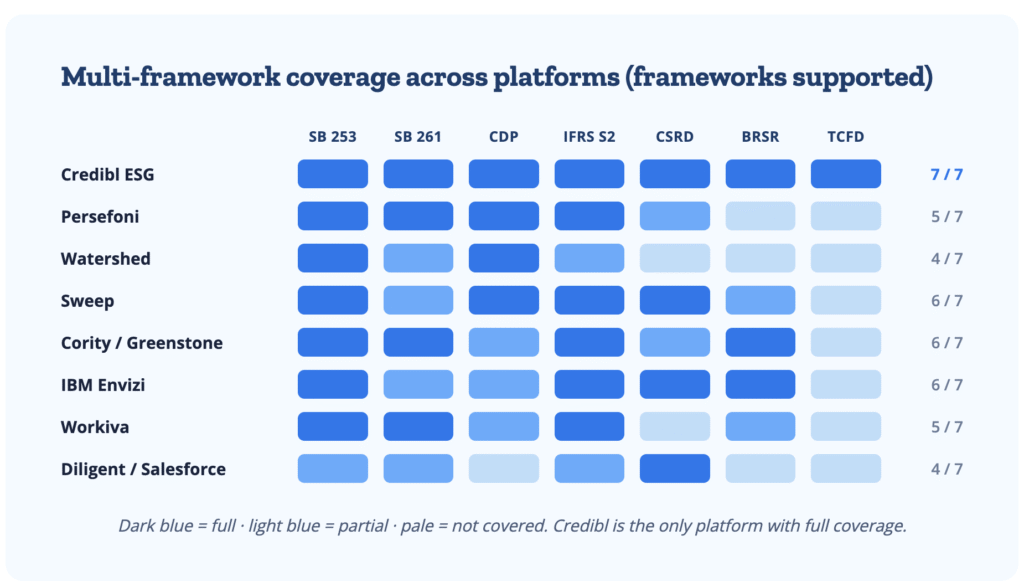
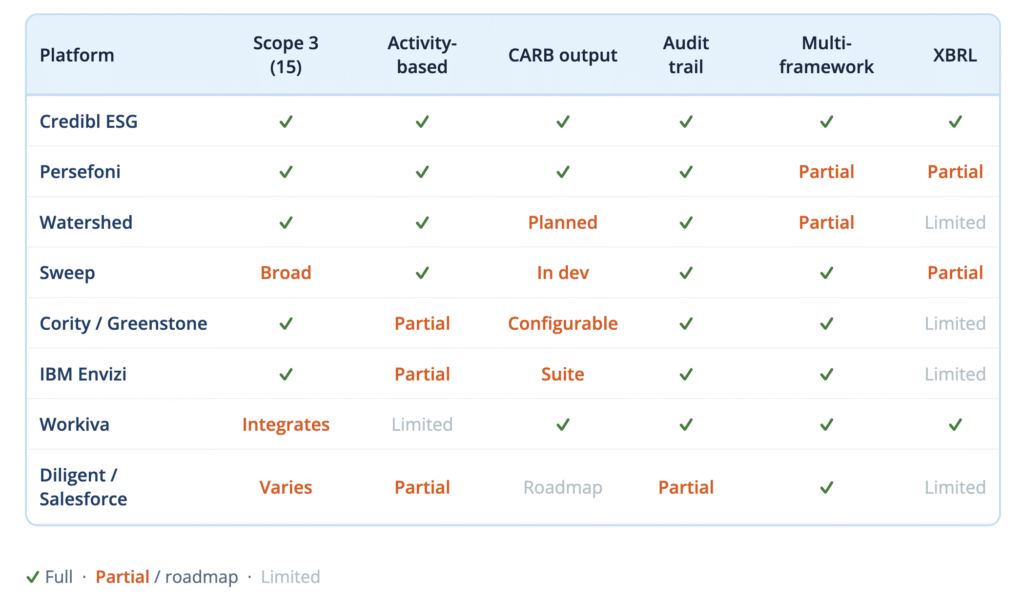
- Credibl ESG is the only platform with full coverage across all six capability dimensions benchmarked below.

What to Look for in an SB 253 Reporting Solution
Four capabilities carry real weight under SB 253’s assurance and format requirements. Everything else is secondary.
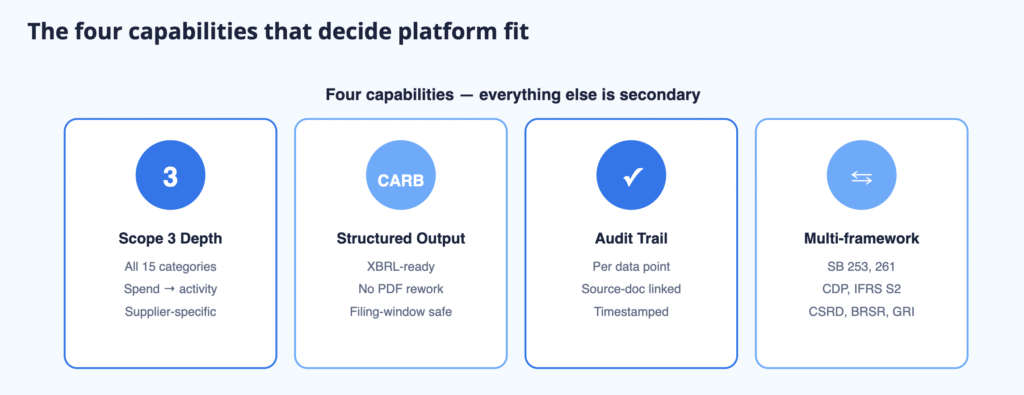
1. Scope 3 coverage with method escalation
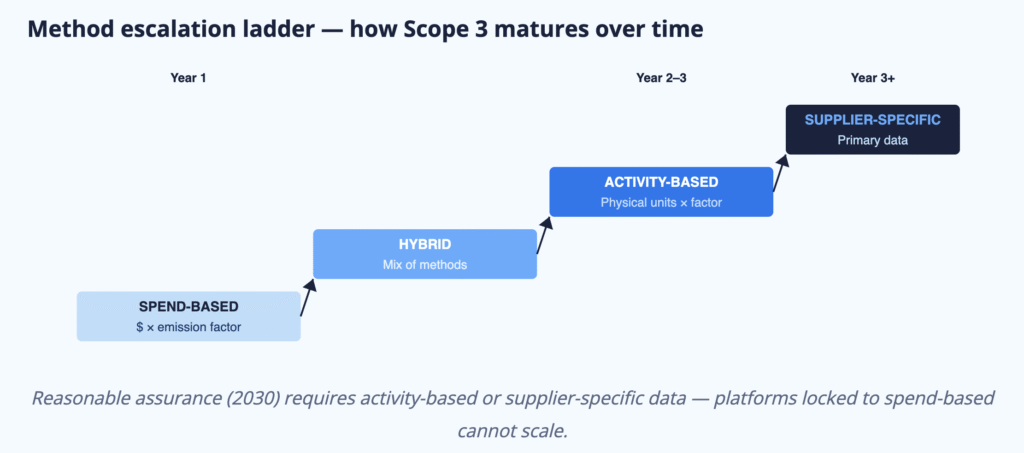
The platform must support all 15 Scope 3 categories and let you progress from spend-based to activity-based to supplier-specific methods as data matures. Platforms locked to spend-based methods cannot pass reasonable-assurance scrutiny in the late 2020s.
2. CARB-formatted output
CARB will require structured submissions in its designated format. “Export to PDF” is not enough. Verify the vendor already has a CARB output template, or has committed to deliver one in advance of the filing window.
3. Audit-grade data lineage
Every disclosed number must be retrievable back to its source document within a few clicks — utility invoice, supplier questionnaire, ERP line item. Auditors test a sample; if 10 data points take 10 hours each to trace, the engagement stalls.
4. Multi-framework mapping
The same underlying emissions data should produce outputs for SB 253, SB 261, CDP, ISSB/IFRS S2, and CSRD ESRS E1 without recalculation. Single-framework platforms force recalculation or data re-entry every reporting cycle.
Top 8 SB 253 and SB 261 Reporting Solutions
Listed alphabetically after Credibl ESG. Vendor claims verified against publicly available product documentation as of April 2026; confirm directly before evaluation.
1. Credibl ESG
Multi-framework native platform with 900K+ emission factors and per-data-point audit trail
- Scope 3 coverage: All 15 categories; spend-based, activity-based, and supplier-specific methods with automatic escalation.
- CARB output: Structured CARB submission format; multi-framework template library.
- Assurance trail: Timestamped per-data-point audit trail with source-document attachments.
- Multi-framework: SB 253, SB 261, CDP, ISSB/IFRS S2, CSRD ESRS E1, BRSR, GRI, TCFD.
2. Persefoni
US-focused climate-disclosure platform with strong CARB-compliance roadmap
- Scope 3 coverage: All 15 categories with activity-based calculation.
- CARB output: Dedicated California-compliance module.
- Assurance trail: Audit-ready data lineage.
- Multi-framework: Strong on SB 253, CDP, ISSB/IFRS S2.
3. Watershed
Tech-first climate platform with emphasis on activity-based Scope 3
- Scope 3 coverage: All 15 categories with emphasis on activity-based Scope 3.
- CARB output: Planned for initial filing window.
- Assurance trail: Strong data lineage.
- Multi-framework: SB 253, CDP, SBTi alignment.
4. Sweep
CSRD-first platform with SB 253 and SB 261 extensions
- Scope 3 coverage: Broad Scope 3 with supplier engagement tooling.
- CARB output: In development.
- Assurance trail: Solid data governance.
- Multi-framework: CSRD-first design with SB 253 and SB 261 extensions.
5. Cority / Greenstone
Enterprise EHS platform with mature audit-trail tooling
- Scope 3 coverage: All 15 categories; enterprise feature set.
- CARB output: Enterprise configurability.
- Assurance trail: Mature audit-trail tooling.
- Multi-framework: Broad framework coverage including CDP, TCFD, GRI.
6. IBM Envizi
Part of IBM’s enterprise sustainability suite
- Scope 3 coverage: All 15 categories with emphasis on utility and energy data.
- CARB output: Part of the broader Envizi suite.
- Assurance trail: Enterprise-grade.
- Multi-framework: Broad framework coverage.
7. Workiva
Finance-led disclosure-assembly platform with XBRL heritage
- Scope 3 coverage: Integrates with calculation engines; strong on disclosure assembly.
- CARB output: XBRL and structured-disclosure heritage.
- Assurance trail: Audit-workflow tooling is a Workiva strength.
- Multi-framework: Handles multiple framework outputs including SB 253, CSRD, ISSB.
8. Diligent ESG / Salesforce Net Zero Cloud
Enterprise-stack aligned with Salesforce or Diligent
- Scope 3 coverage: All 15 categories at varying depth depending on product edition.
- CARB output: In the roadmap for California-specific submission.
- Assurance trail: Enterprise data-governance.
- Multi-framework: Broad coverage.
Platform Comparison Matrix
How to Choose — Decision Framework
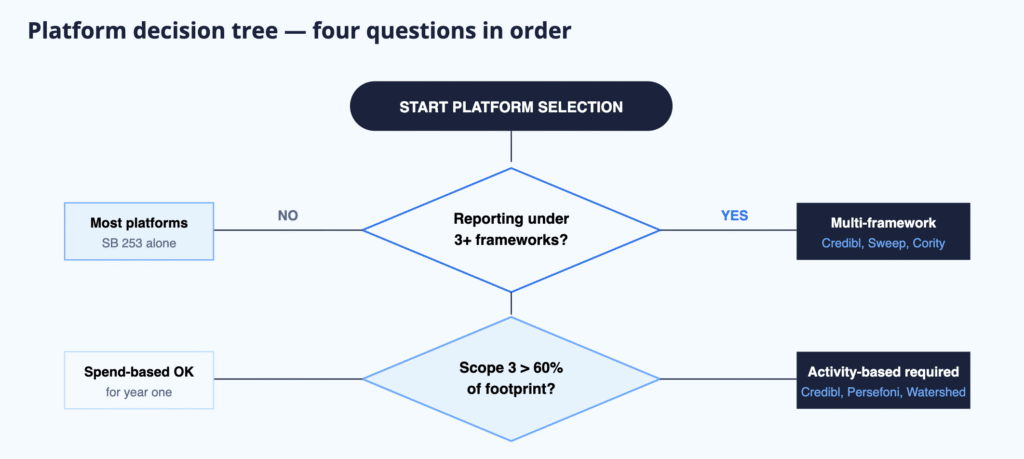
Four questions in order:
- How many frameworks do you report under? One → most platforms work. Three or more → filter to platforms with multi-framework mapping built in.
- Where does Scope 3 sit in your risk register? Above 60% → activity-based is non-negotiable. Below 30% → spend-based plus growth path is acceptable near-term.
- Who owns assurance-readiness? Finance-led programs benefit from platforms with strong XBRL heritage. Sustainability-led programs benefit from GHG Protocol-native platforms.
- What’s your internal data maturity? Strong ERP integration → deep ERP connectors. Utility-invoice-and-supplier shops → platforms with mature data-collection portals.
No single platform is best for all four dimensions. The choice is a fit-to-profile decision, not a feature-count exercise.
How Credibl Supports SB 253 and SB 261 Reporting
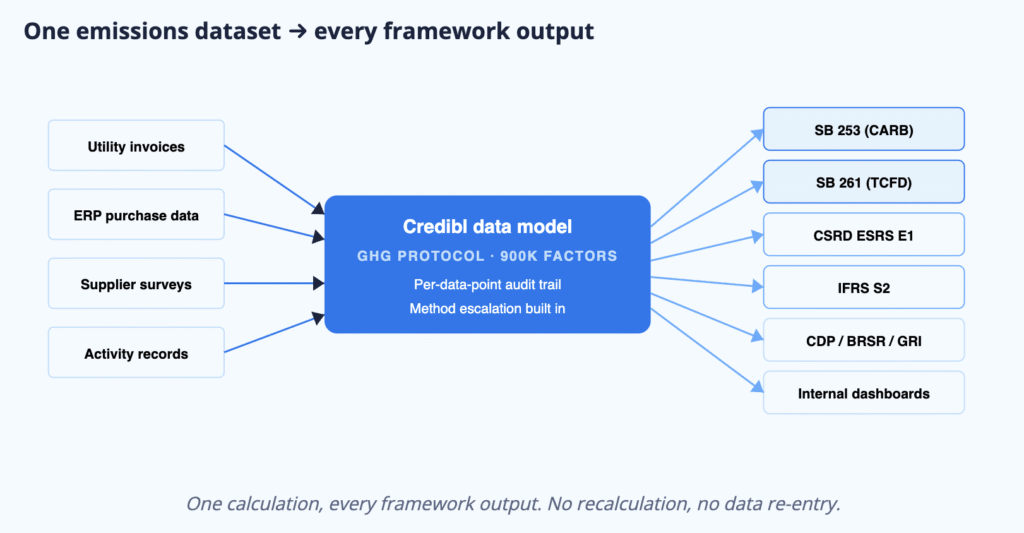
Credibl runs SB 253 and SB 261 as parallel workflows on one data model. Utility and fuel invoices, ERP purchase data, and supplier questionnaires feed a single emissions dataset. That dataset produces:
- CARB-formatted SB 253 submissions
- TCFD-aligned SB 261 climate-risk reports
- Parallel outputs for CDP, ISSB/IFRS S2, CSRD ESRS E1, BRSR, and GRI
Three capabilities matter most for the assurance engagement:
- Emission-factor library — over 900,000 region- and activity-specific factors, versioned and swappable as CARB or GHG Protocol guidance evolves.
- Per-data-point audit trail — every disclosed number links to its source document, emission-factor version, and calculation log.
- Method escalation — Scope 3 categories move from spend-based to activity-based to supplier-specific as data matures, without recalculating history.
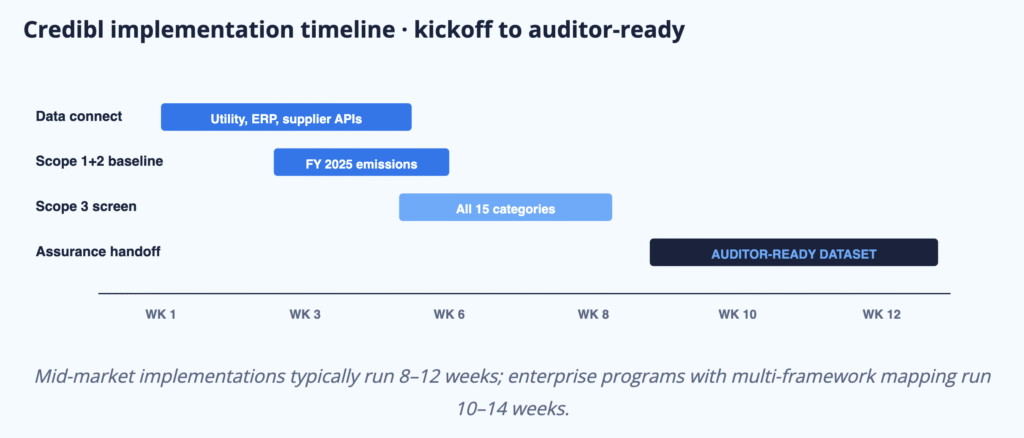
Implementation time for SB 253 and SB 261 on Credibl averages 8–12 weeks from kickoff to first auditor-ready dataset.
Frequently Asked Questions
Can we use spreadsheets for SB 253 compliance?
Not sustainably. Spreadsheets can produce the calculations, but they cannot produce the per-data-point audit trail assurance providers require. First-year spreadsheet-based reporters typically rebuild on a platform before year two.
Is a CDP platform sufficient for SB 253?
CDP uses GHG Protocol methodology, which is reusable, but CDP’s reporting format is not CARB’s format. Expect to either use a platform with both outputs or do post-processing before filing.
How much does SB 253 reporting software cost?
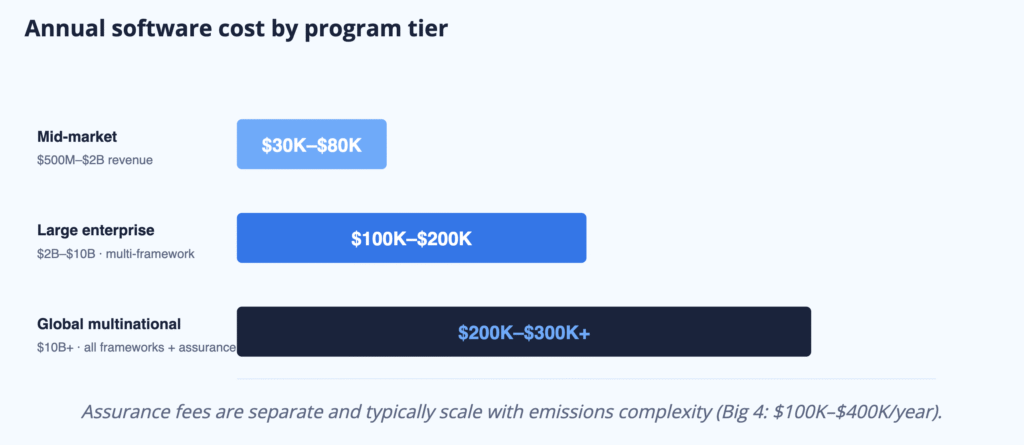
Mid-market implementations run $30K–$80K annually; enterprise programs with multi-framework coverage run $100K–$300K+. Assurance fees are separate and typically scale with emissions complexity.
Do we need separate software for SB 261?
No. Any platform with climate-risk scenario tooling can handle SB 261. The benefit of using one platform for both is that SB 261 scenarios draw from the same emissions baseline disclosed under SB 253.
What if CARB changes its output format?
Platforms that build against the GHG Protocol data model, rather than hard-coding to CARB’s current template, absorb format changes as a templating update. Vendor roadmap conversations should confirm this flexibility.