





Introduction
The Carbon Border Adjustment Mechanism (CBAM) is stepping into a transformative phase in 2026, and it’s poised to affect importers and manufacturers across global supply chains. With its expanded scope now encompassing more products and a shift from reporting to financial compliance, businesses both inside and outside the EU need clarity on what’s coming and how to prepare.
What Is CBAM? A Beginner-Friendly Overview
The Carbon Border Adjustment Mechanism is an EU climate policy designed to prevent carbon leakage, where production moves outside the EU to avoid strict carbon pricing, by ensuring imported goods face a carbon cost comparable to EU-made products under the EU Emissions Trading System (EU ETS).
CBAM works by requiring EU importers to report emissions embedded in certain imported goods and starting in 2026, to purchase CBAM certificates that reflect the carbon price these emissions would have incurred under the EU ETS.
- CBAM certificates are priced in line with emissions allowances under the EU ETS, a system covering roughly 40% of the EU’s total greenhouse gas emissions and a cornerstone of Europe’s decarbonisation strategy.
- Importers must demonstrate the embedded emissions in their products each year and surrender certificates to match those emissions.
CBAM Timeline: From Reporting to Paying
Phase 1: Transitional Phase (2023–2025)
- Reporting only: Importers of CBAM-covered goods must record and report emissions data quarterly.
- No financial obligation yet, allowing companies time to build systems and data credibility.
- This transitional regime aligns with the gradual phase-out of free EU ETS allowances.
Phase 2: Definitive Phase (From 1 January 2026)
- Importers must purchase and surrender CBAM certificates representing emissions embedded in imported goods.
- Public authorities begin matching emissions to carbon prices, creating an economic incentive to decarbonise supply chains.
- Some recent regulatory updates propose delaying actual CBAM certificate sales until February 2027, but the compliance framework (including reporting and data accuracy) still begins in 2026.
CBAM Scope Expansion in 2026: What’s New?
CBAM was initially introduced for a core set of high-emission sectors, but in 2026 several changes take effect:
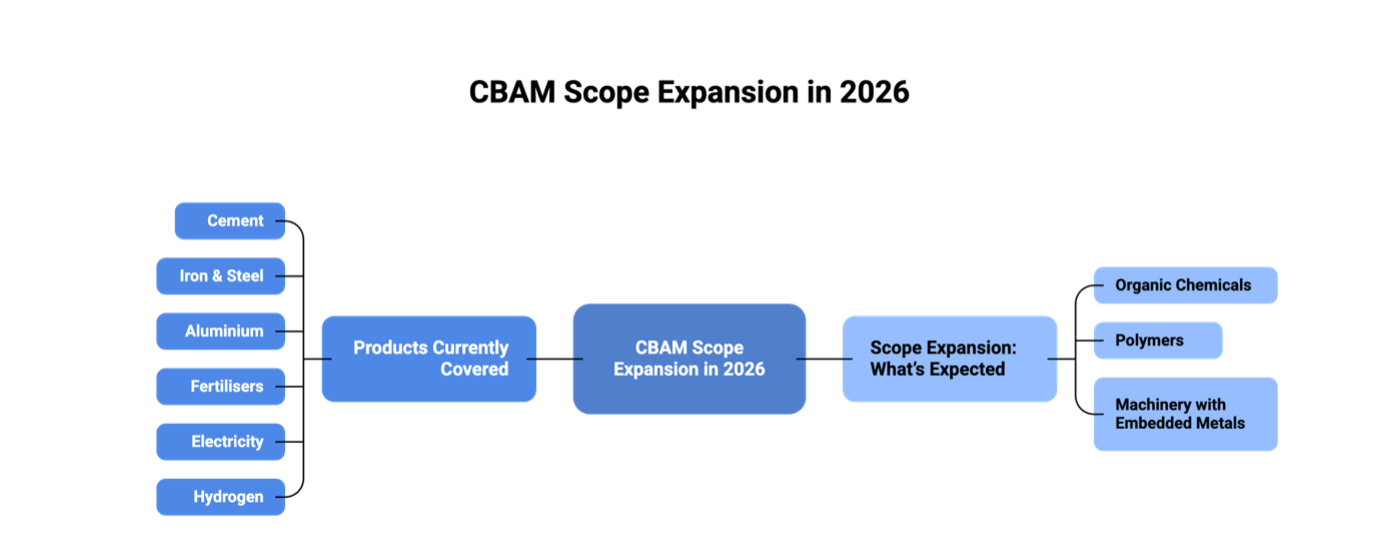
Products Currently Covered
Starting in 2026, CBAM definitively applies to imports of goods in the following sectors:
- Cement
- Iron & steel
- Aluminium
- Fertilisers
- Electricity
- Hydrogen
These represent products with high carbon intensity and risk of carbon leakage.
Scope Expansion: What’s Expected?
While goods like organic chemicals and polymers were discussed in proposals as potential future expansions, implementation for many downstream and complex products (e.g., machinery with embedded steel and aluminium) is planned to roll out from 2028 onward under EU proposals, though 2026 remains the turning point for stricter compliance for core sectors. EU Commission operational rules & scope extension proposals (Mayer Brown).
What Products and Emissions Are Covered?
CBAM regulates embedded greenhouse gas emissions, including:
- Direct emissions from manufacturing processes
- Indirect emissions such as electricity use when producing goods like aluminium or steel
Importers should work with suppliers to collect verified emissions data , otherwise regulators may apply default values, which tend to assume higher emissions.
Explore more on emissions coverage here: CBAM: What will change overview.
Implications for Importers based in the EU
If your business imports covered goods into the EU, you’ll need to take on new obligations, such as:
- Register as an Authorised CBAM Declarant with the national competent authority of the EU Member State where you are established or via the EU CBAM Registry
- Collect and verify non-EU supplier direct emissions data
- Submit annual CBAM declarations
- Purchase and surrender CBAM certificates
Authorities now allow non-EU operators to upload their emissions data to a shared system, potentially reducing administrative duplication.
👉 Official CBAM Registry & Reporting guidance: CBAM Registry and Reporting (European Commission).
Implications for Manufacturers (EU & Non-EU)
Non-EU Producers
- Must support importers with accurate, auditable emissions data aligned with EU methodologies.
- Might need to upgrade monitoring, reporting, and verification systems.
EU Manufacturers
- Many will benefit from reduced carbon leakage risk as imported competitors face similar carbon costs.
- However, their suppliers will also have to adjust to meet tighter reporting expectations.
CBAM effectively encourages emissions transparency across global supply chains, pushing climate accountability upstream.
Practical Tips to Prepare for CBAM 2026
- Map Your Exposure Early – Identify relevant products, HS codes, and suppliers now.
- Engage Suppliers Soon – Early emissions data collection avoids default values and surprises.
- Build Audit-Ready Data Systems – Ensure data traceability and documentation for compliance.
- Align with EU ETS Methodologies – Follow EU-recognised frameworks for calculating emissions.
- Run Cost Scenarios – Model financial exposure to CBAM certificates using up-to-date ETS prices.
Final Thoughts
The CBAM scope expansion in 2026 marks a turning point in global climate policy and trade compliance. What began as a reporting requirement has evolved into a fundamental cost driver, and a strategic consideration for importers and manufacturers worldwide.
Whether you’re trading carbon-intensive goods into the EU or supplying products across borders, preparation and transparency are non-negotiable. Leveraging tools like Credibl can help turn regulatory obligations into business insights and competitive advantage.
How Credibl Helps You Stay CBAM-Ready?
CBAM compliance goes beyond reporting; it requires operationalising emissions data across complex value chains, and that’s where Credibl can make a difference.
With Credibl, you can:
- Centralise supplier emissions data in one platform
- CBAM-aligned emissions calculations
- Maintain audit-ready documentation
- Forecast carbon costs and certificate obligations
- Prepare for reporting and financial compliance starting in 2026
Book a CBAM readiness demo with Credibl and turn regulatory complexity into a competitive advantage.
FAQs:
- When do CBAM payments start?
Definitive compliance with financial obligations begins in 2026, with CBAM certificate sales expected from early 2027. - Who must comply?
EU importers of covered goods, regardless of where the goods originate. Non-EU manufacturers must provide emissions data. - What if data is missing?
Regulators may apply default emissions values, usually higher than real emissions, leading to higher costs. - Does CBAM replace the EU ETS?
No. CBAM complements the EU ETS by levelling carbon costs on imports. - Will CBAM expand further?
Yes, further scope expansion, including more downstream products, is planned beyond 2026.